While AI isn’t taking away the jobs of visual practitioners just yet, it’s worth keeping an eye on how its performance is going. I put two AI image generators through their paces, and compared them to another experiment I ran in 2022. The results are indeed gobsmacking.
Back in August 2022, I tried out MidJourney to see how it would visualise company vision statements. This was partly to use generative AI in a (semi) practical way, but also to see if it was basically going to steal my job, i.e. helping organisations visualise their strategy.
Company visions, and the power of process
I help teams gain clarity and direction through visualising their complex and often ambiguous information and ideas. So, if I were to go toe-to-toe against MidJourney (or any generative AI platform), I thought I’d choose something that we can all reference, as a starting point.
The other reason I experiment with company visions has more and more to do with a very important aspect of visualisation: the process is usually just as important as the product. In other words, how a group of people arrive at their vision statement – indeed any important piece of work they collaborate on – is always just as insightful, instructional and important as the vision statement itself.
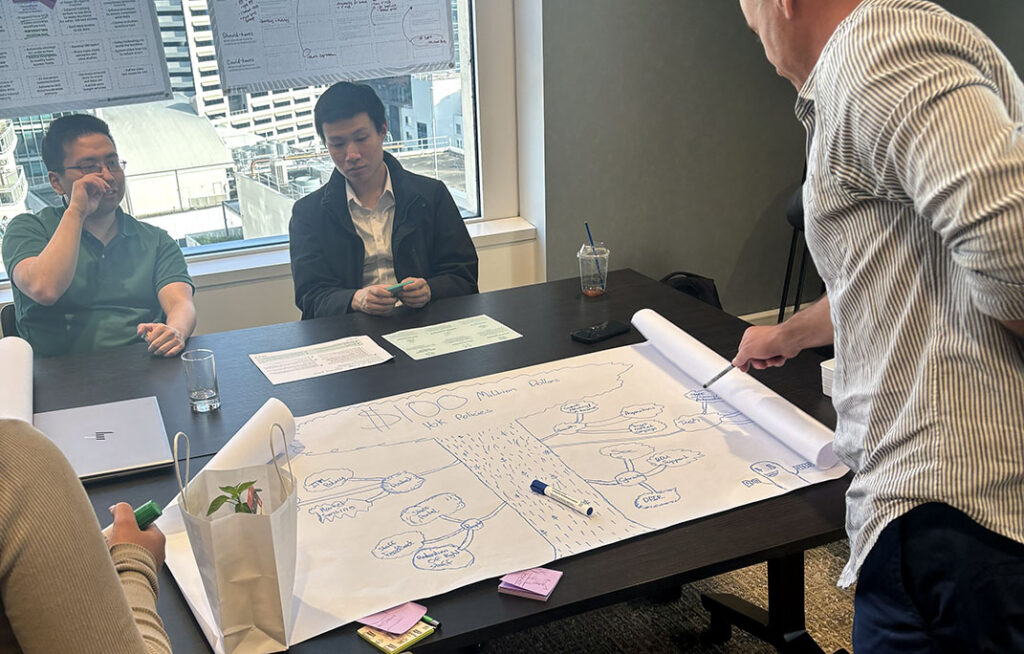
All creatives know this, and this is why AI-generated ‘art’ (and blog posts, emails, presentations, etc) continues to be somehow hollow, soulless, and formulaic. The person has not been part of the process.
Imagine watching an AI-generated game of football, simulating your favourite team facing another team you don’t like. It might look like the real thing, but it’s all fake. Would you watch it?
That’s what us creatives feel like when it comes to AI generating anything creative.
A quick addition on method
Just to be clear, the only text I used in each prompt was the vision statement, so it was completely up to AI to imagine what it wanted. This time around, I thought I would also use OpenArt as well, since at the time of writing Nano Banana (Google’s latest image and video generation engine powering OpenArt) has been getting a lot of attention. I’ll show you the results side-by-side.
Results: a huuuuge difference
The results of visualising company visions in 2022 were… curious, to say the least. MidJourney was young, the results were all pretty abstract, and the user interface was Discord, which made it a bit cumbersome. Now as you’ll see, the images it generated using the exact same prompts are vastly different. Let’s dive in, shall we?
Nike
The first vision statement out of the gates is Nike’s: “To bring inspiration and innovation to every athlete in the world“.
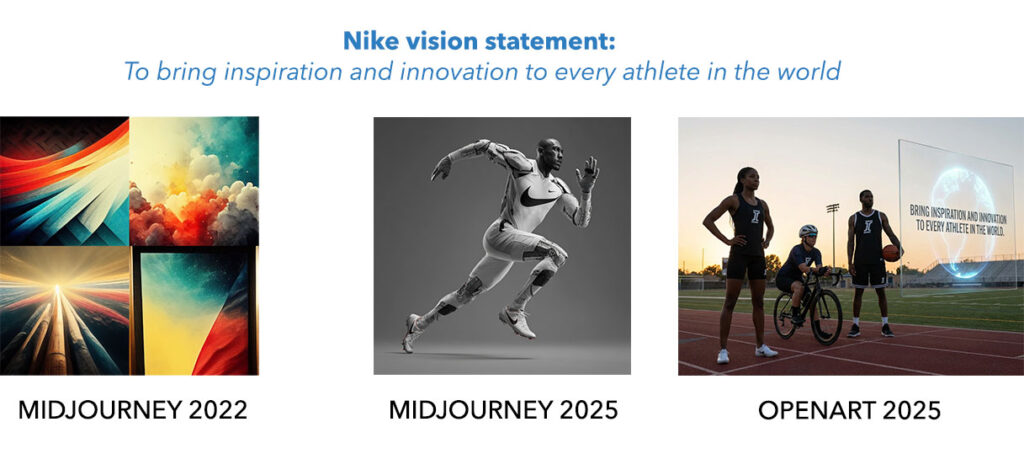
The difference is gobsmacking indeed. Is that Kanye West…? Interesting that MidJourney has included the Nike logo, which OpenArt has opted for a blend of real-world location with a digital holographic display. That must be the ‘innovation’ bit.
Amazon
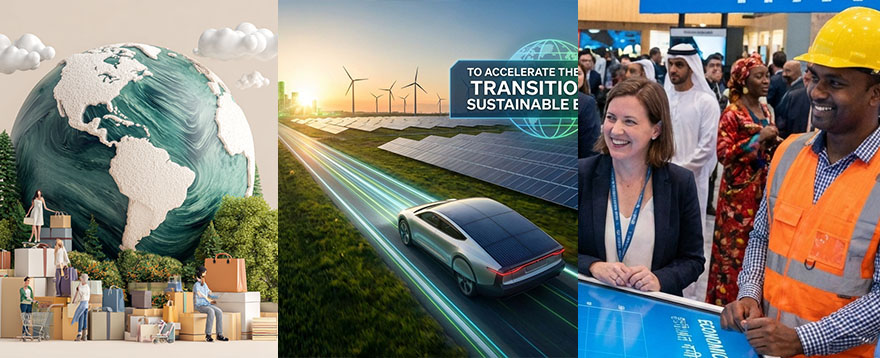
What about the business headed up by a man who is currently earning $900 to over $3,700 per second? Its vision statement is: “To be Earth’s most customer-centric company, where customers can find and discover anything they might want to buy online“.
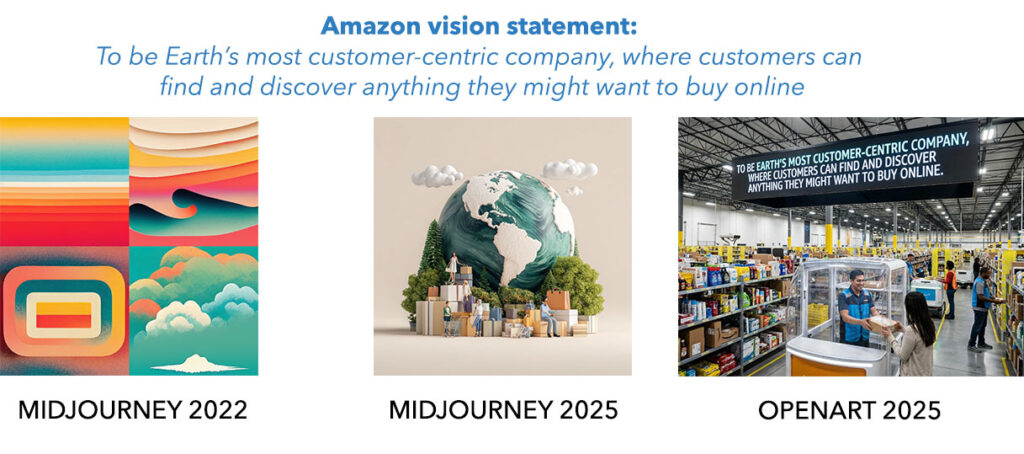
I was quite partial to the abstract variations MidJourney generated back in 2022, but now it’s a very literal take on the text (Earth: check, buy: check) derivative 3D-modelled scene. I can see a lady with three legs… it’s nice to see that some things never change.
Tesla
Tesla, the company that makes cars that call its HEPA air filtration system “Bioweapon Defense Mode”, has this vision: “To accelerate the world’s transition to sustainable energy“.
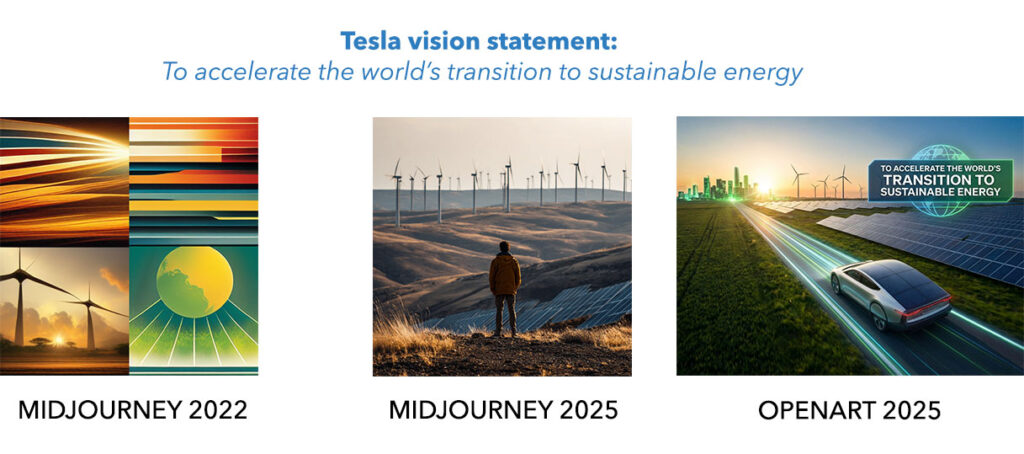
Windmills are clearly the enduring symbol of ‘sustainable energy’ (not that I have a problem with that at all). OpenArt’s rendering ticks all the boxes, but MidJourney’s version is a bit unsettling… And ironically, the solar panels are in the shade.
Trivia question: guess what the most common job title is for profiles on LinkedIn? Founder. Hmmm… Anyhoo, LinkedIn’s vision statement is: “Create economic opportunity for every member of the global workforce“.
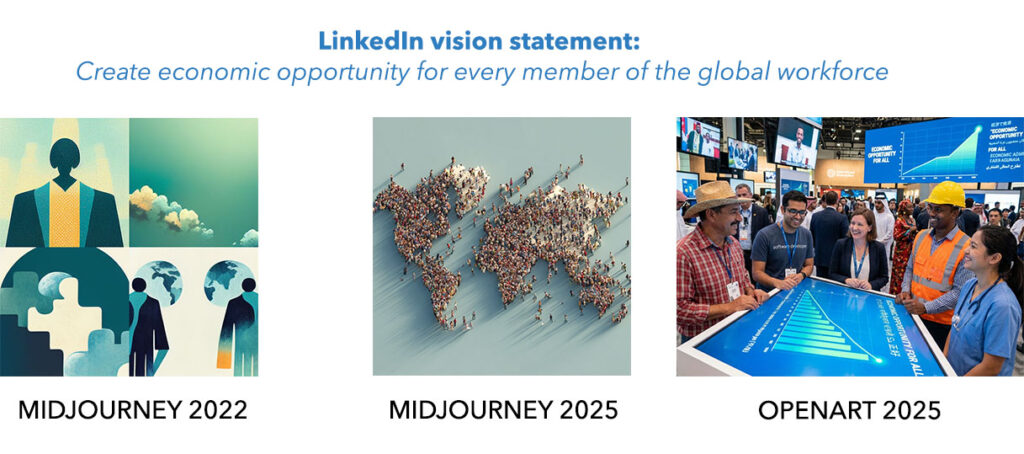
It’s interesting how OpenArt has visualised ‘global workforce’ not only as a set of gender- and ethnically-mixed people in the foreground, but also that they all have clothing representing different jobs, AND they’re at some sort of conference where people of other nationalities are in the background, AND a chart! My word.
Conclusion?
Let me say that I am not a fan at all of generative AI. The environmental cost alone is astronomically and irresponsibly high and unsustainable, not to mention the disruption it’s causing to the creative industry, as well as the social cost (e.g. displacing community-building projects because data centres are being built on lower-cost residential land instead). Hardly any businesses that have invested in AI have seen any value created, while (at the time of writing) it’s still being propped up by investors, creating a bubble that will pop soon.
That said, I do still use generative AI tools, and I use them in targeted strategic ways. Does this weigh on my conscience? Very heavily, yes. I am well aware that the images I generated here alone cost about 8 glasses of water.
I’m excited by the movement to make generative AI greener and more ethical, like GreenPT and EthicalGPT, and the more we can all play an active role in making such technology more ethical and sustainable, the better.
So to make those 8 glasses of water more worthwhile: my take from the results above is that the Nano Banana model is much more sophisticated than the MidJourney model. It seems to do a better job of making sense of the words in each vision statement, and detecting context, whereas MidJourney’s pictures were much more literal and derivative.
But the thing is, you probably wouldn’t just use the words of a vision statement as the whole prompt; you would be adding other aspects, such as:
- The role you want the model to assume
- More information about context (i.e. why you want the image and what you want to use it for)
- The target audience of the image
- The pictorial style you’re after
- Aspect ratio, colour(s) and so on
What have your results been like, if/when you use AI image generators? I hope this stimulates some ideas for you.