Life is full of all kinds of people, and your drawings can be too, with these ideas and examples.
UPDATE: A lot has changed since I first wrote this post (in 2018). It’s tempting to rewrite the whole thing, but I’ll save that for another new post. That said, I’ve redrawn my example drawings here, plus a few other updates…
It’s a very good thing to make your presentations and business communications as inclusive as possible for your audience (by showing more diversity), and of course hand-drawn images are always going to be eye-catching and interesting. But it can be a real struggle to draw any face or figure in a way you’d want to show your colleagues, let alone different varieties of faces and figures.
Well, that’s what this post is for. Let’s look at some simple ways to draw more diversity in figures and faces, for you to use in your presentations, and other things like whiteboard drawings in meetings, user interface designs, journey maps, and storyboards.
‘Diversity’ = Inclusion
It can be tempting to think that ‘diversity’ in visual communications means you have to ensure there is every combination of gender, age, lifestyle, life stage, ethnicity and sociodemographic background possible in your drawing. And look, there might be times where that’s what is called for.
But for me, it always comes back to making communications as relatable as possible to the target audience. It’s not about you (or maybe even the corporate brand you might be drawing for). It’s about the audience, and working out how best to include them.
In drawing, detail and diversity go together
Look at the range of faces below. The more abstract a face, the less you need to worry about facial diversity, but the more detail you add, the more facial diversity — or lack thereof — will become an issue.
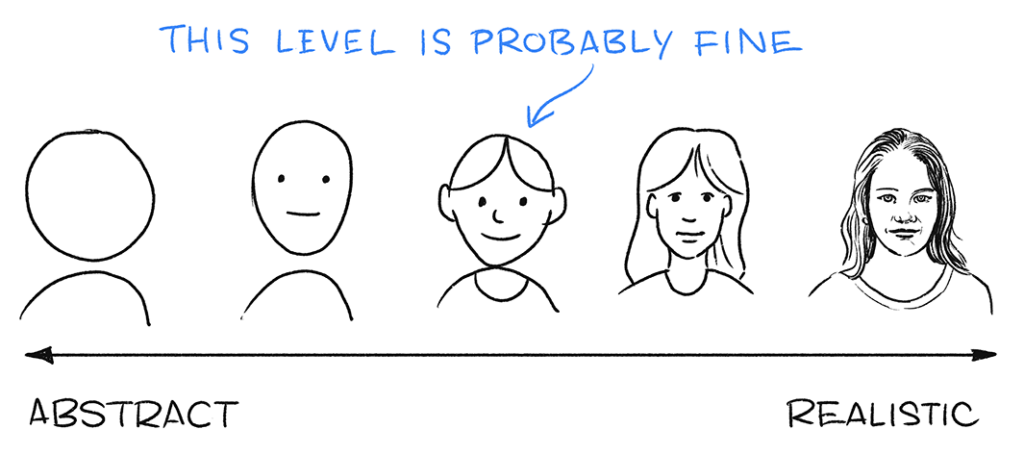
I always advise to work on a sketching style (or fidelity) that’s got only a little bit of detail; that way, you can suggest diversity in easy, economical ways. You can also help your audience to focus on what is most important. After all, the most important thing you need to communicate might be more about the diversity of what your figures are doing together rather than diversity of looks.
Think about head shape
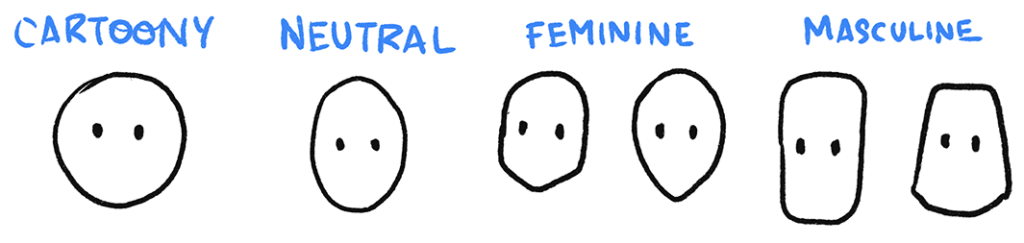
The shape of the head is a good place to start when doing simple hand-drawn pictrues of faces. All of the examples I show you here are using a low level of fidelity; simple lines, no mouths, that sort of thing. Firstly, think about the shapes of the heads you draw. Almond-shaped heads with slightly pointy chins appear more feminine, and squarer-shaped heads appear more masculine.
Hair’s the easiest way to variety
The hair is the next easiest way to indicate a variety of gender, age, and ethnicity. The picture below shows how adding just a simple line here and there can indicate some differences:
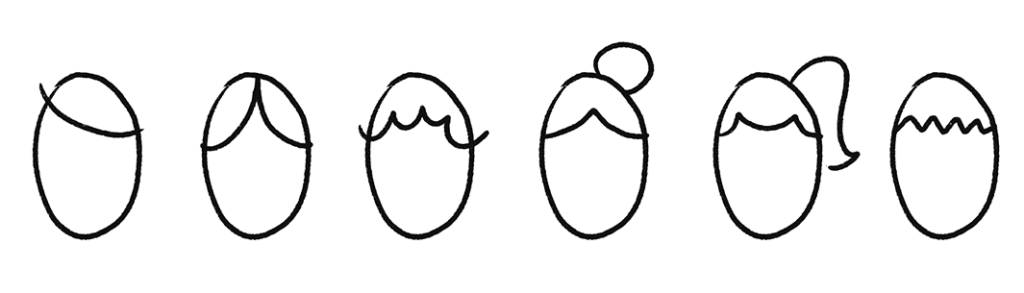
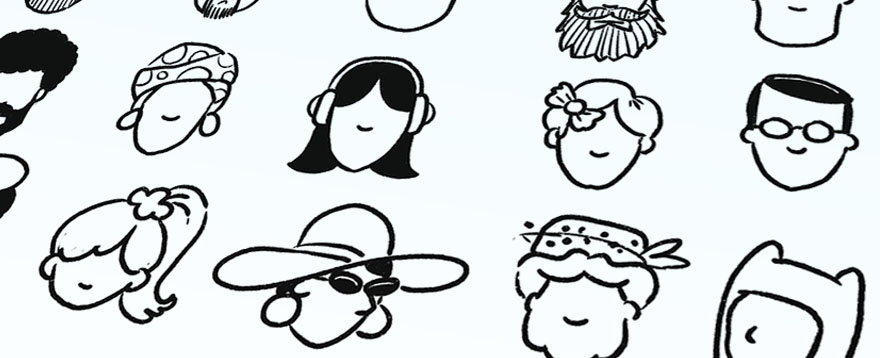
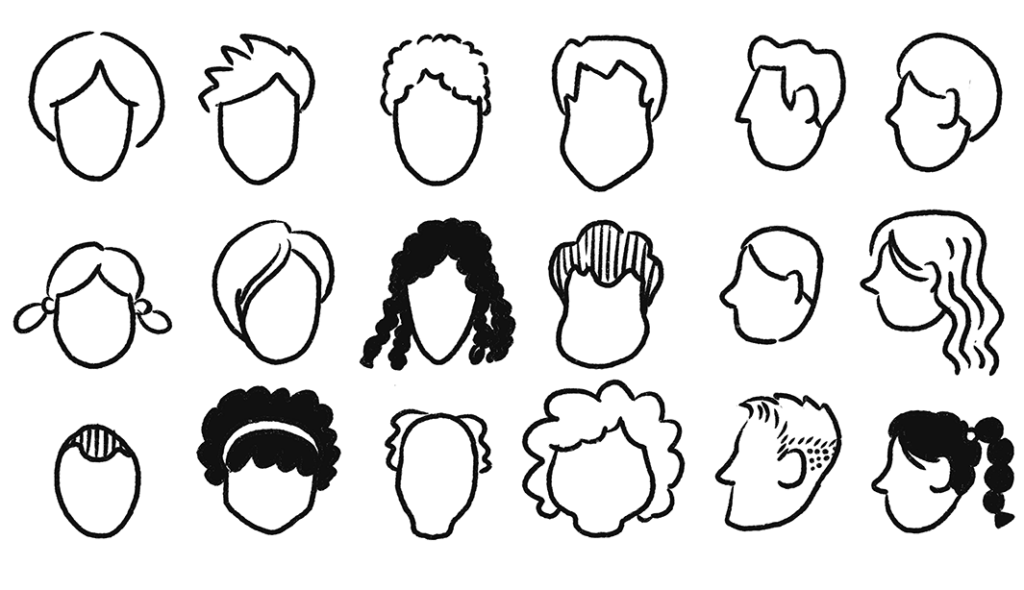
Once you master those simple lines, try drawing different shapes and varieties of hair as seen below: young spiky hair, long wavy feminine hair, emo hair with a streak through it, permed hair or balding hair. Notice how using parallel lines, or inking in the whole hair shape is visually interesting, too. Close-cropped curly hair is also a good way to show someone whose gender is not identified by hair shape.
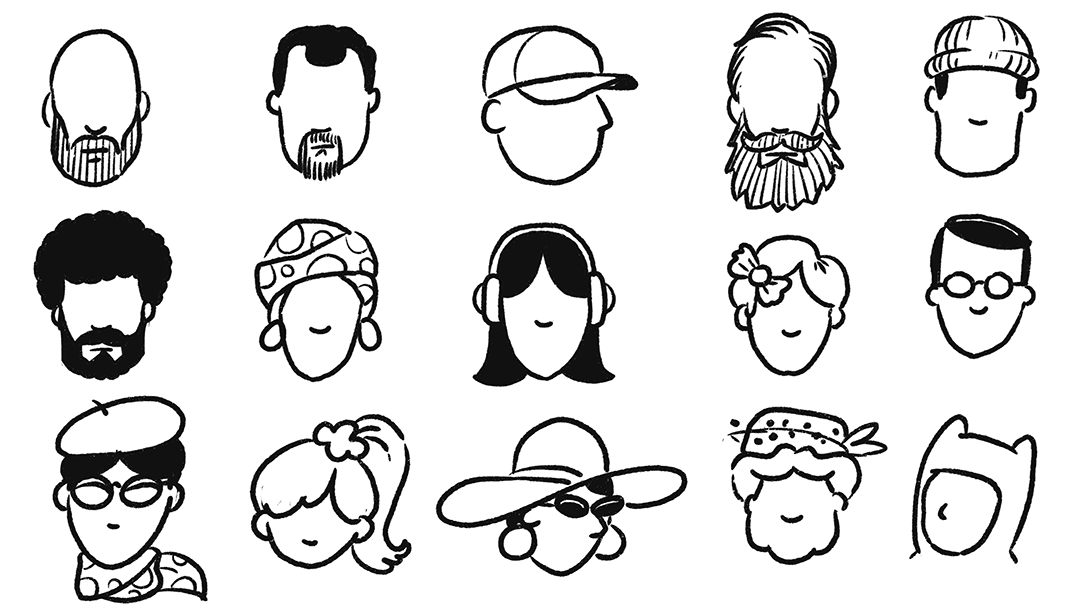
Beards, facial hair, and accessories like headbands, glasses, caps and other headwear are also great ways to indicate various flavours of lifestyles:
Little details mean a lot for different ethnicities and religions
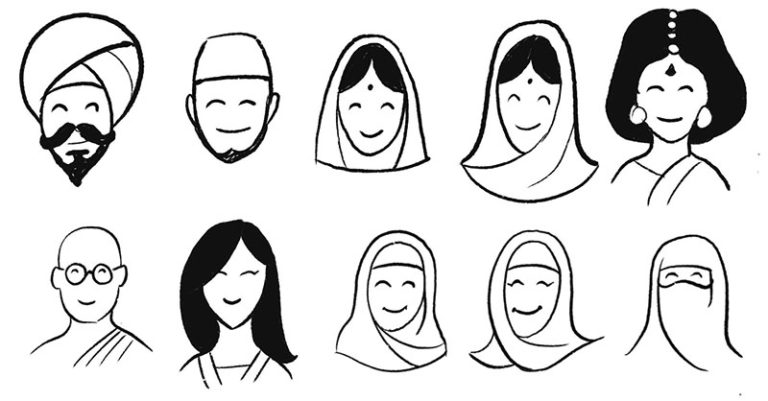
It’s worth investing a little bit of time practising the faces below, so that you can include different ethnicities and religions in your drawings.
Seen here in the top row from left to right: a Sikh turban (the dastar), a Muslim skullcap (taqiyah or topi), two Indian head coverings (chunni), and an Indian woman with a tikka and sari. In the second row from left to right: a Buddhist wearing a Kasaya, an Asian female (the clothing is simple enough to be a Vietnamese áo dài or a Chinese cheongsam), two hijabs (simple enough to be Al-Amira or Shayla style), and a niqab.
Diversity applied to figures
Just like faces (above), we can indicate a lot more diversity in the poses and situations of figures, too. By thinking about different ages and stages (childhood, parenting, older age), we can add a whole lot more variety to the figures we sketch. Here are just a few examples:
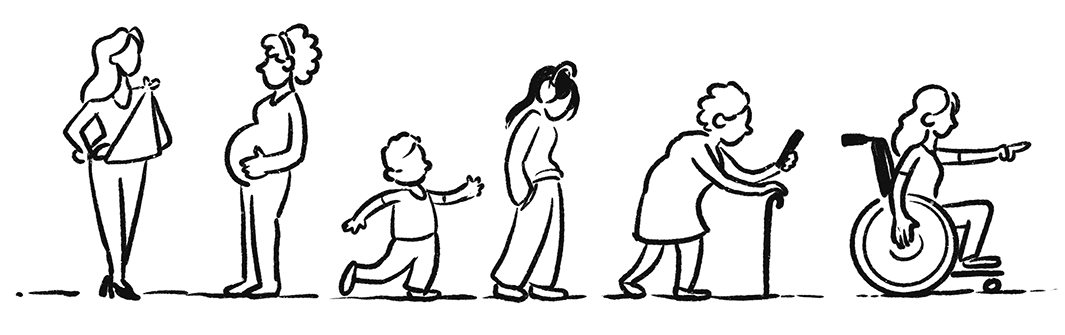
Think about different life situations (like parenthood), and different levels of ability and mobility as well.
One thing I like to think about when drawing more inclusive figures like this: even if I do a figure with a walking stick or in a wheelchair, I never want that thing to define them as OLD or DISABLED. That’s a stereotype. Instead, I like to include some little detail to show the figure doing something, using something… not just being a static figure representing a stereotype.
And in a similar way to the faces above, adding a bit of detail to indicate different dress can indicate more variety and inclusivity too (in the case above, the female figure is wearing a sari and maybe a choli).
Your turn
I hope this helps you think about how you might be more inclusive for your audiences in the way you draw, whatever you draw, and whoever you draw. And I bet you that everyone around you will really appreciate it, too.
Other things worth reading
- Representation in graphic recording – a really insightful reasoned article by ImageThink
- You can’t just draw purple people and call it diversity – an amazing analysis of the unconscious biases that dog us all, and then some, by Meg Robichaud and her drawings she did for Shopify
…
Would you like more of this sort of thing in your inbox every week to help you be more clever, and more valuable to your team? Then why not use that there box at the top right of this page, and sign up to the Presto Sketching newsletter. I send tips out weekly, and I make them as useful as possible.