Think about you and your team at work for a minute. How supportive would you say it is for everyone to speak their mind, try new things, and learn from mistakes? Is it a pretty open, encouraging team, or is it rife with politics? Do you feel like you can be yourself there?
This is what psychological safety is all about: having a culture where you and your team can bring your whole selves to work, speak your mind with respect for each other, trust each other, be curious, be assured that it’s okay to try new things, and not be penalised speaking out, or for taking small risks. Psychological safety is essential if an organisation wants to have a culture where inventing and implementing breakthrough ideas can thrive.
Using sketching to promote and embed psychological safety
That sounds like a pretty good culture to work in, doesn’t it? So how can you promote and embed that sort of culture? By using more sketching and visualising in your team, of course! Here are 3 ideas to get you going, that I’ve used in a variety of meetings and workshops.
1. Draw project ‘horror movie’ posters
I’m a big fan of awesome movie posters, as well as pre-mortem activities, where a team can discuss what they think could go wrong in a project at the beginning of the project, and then discuss what they can do to avoid those things. This is a great way for everyone to be more real with each other, air those anxieties, and be more connected by realising that everyone probably feels the same anxieties.
At the beginning of a project as part of a kick-off meeting, ask everyone to imagine (in silence) the project as a horror movie or disaster movie, where everything they think could go wrong HAS gone wrong. Then, give everyone a sheet of paper and a pencil or marker, and ask them to each draw a promo poster for that movie, showing what has gone wrong.
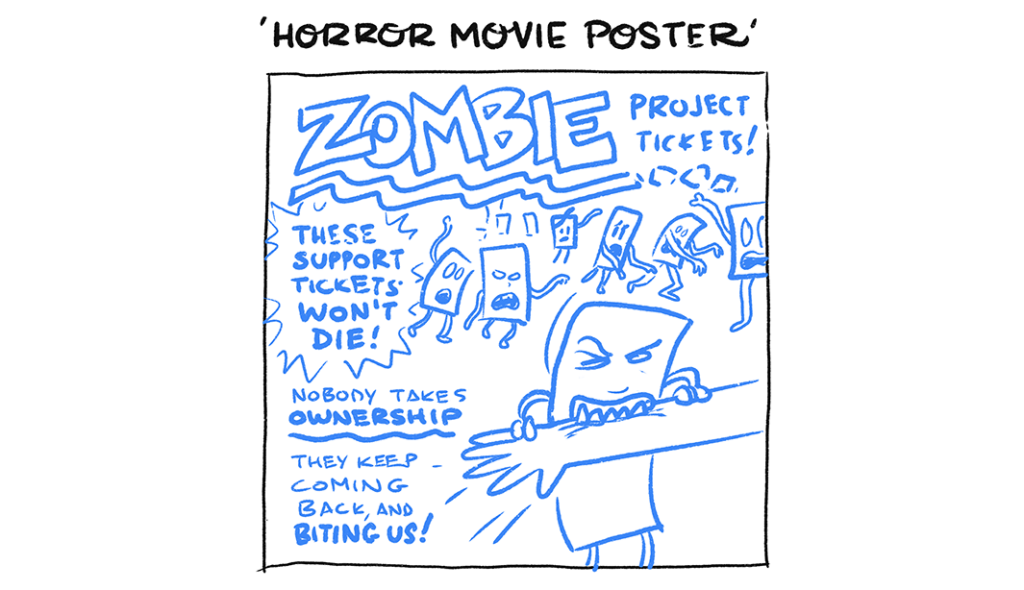
The drawing doesn’t have to be good at all; just enough to get their idea across. And like all visualisations, just getting those vague thoughts out of people’s heads and out in the open can be really clarifying. It gives everyone a way to express themselves without using words… which is a great way to side-step the usual lot of clichés and ‘corporate script’ ‘safe’ way of saying things.
Facilitator tip: You can put everyone at ease by showing them a ‘bad’ drawing you’ve done yourself, earlier. This itself is a great way to demonstrate psychological safety.
Once everyone has finished (after 5 or so minutes), get everyone to stick them up on the wall, and let everyone tell each other about what they’ve drawn. Then, discuss as a team how to avoid those things going wrong. It’s fun, it’s really revealing, and it bonds the team a bit closer together.
2. Do a ‘Circle of expectations’ sketch
Another good activity to do during a project kick-off, or whenever someone new starts on the team, is to do a ‘Circle of expectations’ sketch. Draw a big circle on a whiteboard, and write ‘IN’ in it. Outside the circle on one side, write ‘OUT’.
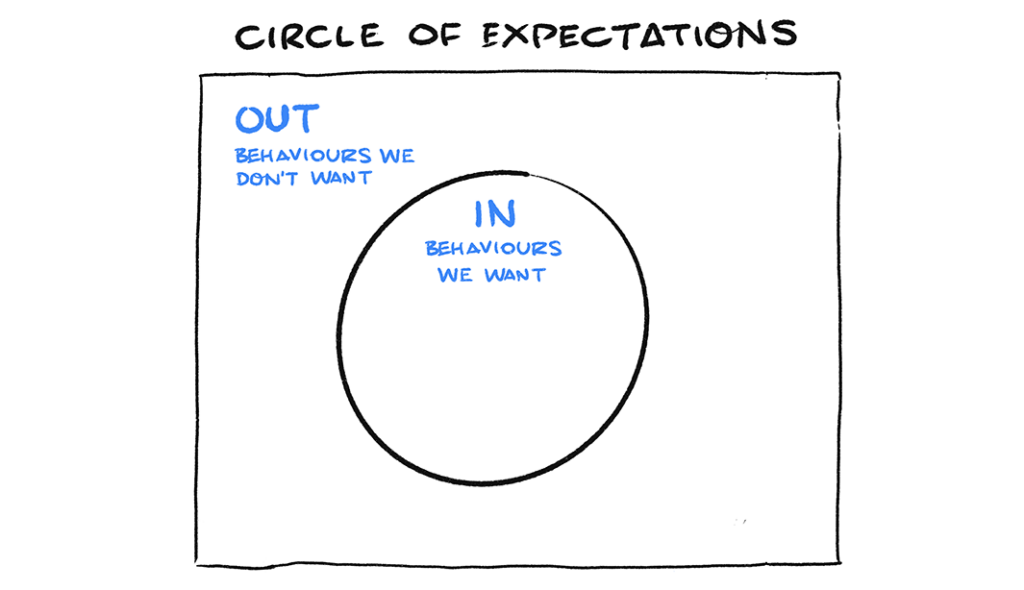
Set the scene by saying that everyone has a part to play in the culture of the team, and this is the opportunity to state what behaviour expectations we all have. Just like the Disaster Movie Poster idea above, It’s a good idea to demonstrate what you’d like everyone else to do, so go ahead and write something like ‘WE DO THE TASKS WE SAY WE’LL DO’ inside the circle.
Ask everyone to grab a whiteboard marker (or a marker and sticky notes) and write what behaviour they think everyone should have in the team inside the circle. And then ask everyone to write what they don’t want outside the circle.
Then, discuss as a group:
- How to make sure that everyone does what is inside the circle, and avoid what’s outside the circle. This is a great way to foster honesty.
- How to keep each other accountable. What will everyone agree to do if behaviours outside the circle happen? This is tough to talk about, but it will show how having each others’ backs is really important.
3. Draw a superhero drawing of yourself
This is a fun and very insightful 15-minute ice-breaker activity to do with your team. Ask everyone to draw a simple outline of a superhero on a sheet of paper (you can use something like the image below as a template if you want).
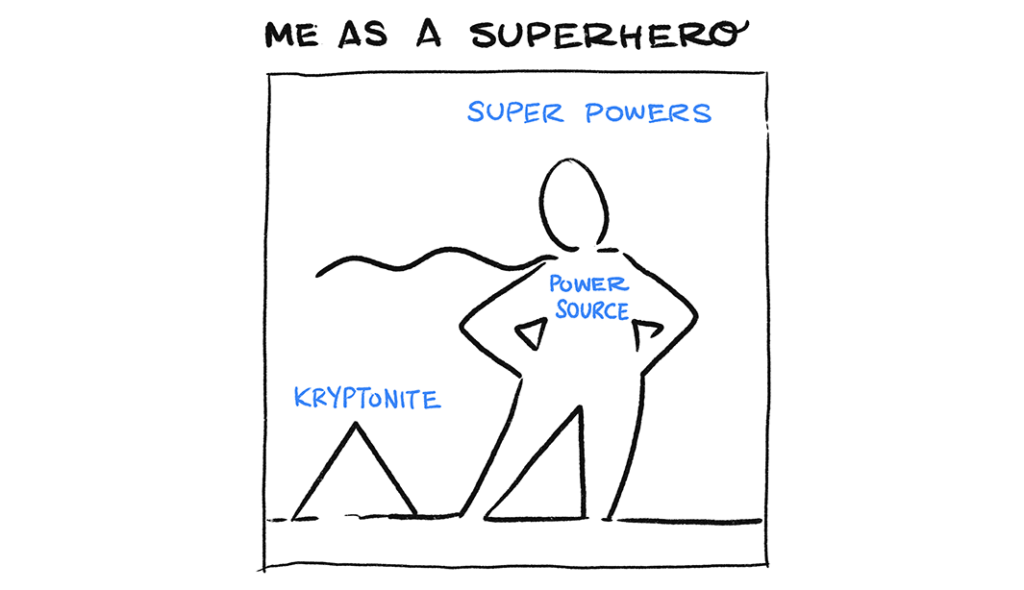
- Ask everyone to imagine themselves as a superhero, and then write or draw their own SUPER POWERS around the outline. It’s totally fine to be a bit silly with this; it gives people a chance to get past any awkwardness about drawing and sharing this sort of stuff.
- Then, ask people to write or draw what they really value inside the outline; this is the POWER SOURCE of you as a superhero. You might want to drop hints by including things like authenticity, honesty… things that reveal what really motivates you.
- Thirdly, ask everyone to write or draw their KRYPTONITE, the things that make you anxious, annoyed…the things that sap your mojo.
As with all of these activities, get everyone to talk through what they’ve drawn, and discuss as a group how you can support each other to stay connected to your power sources, use your super powers to help each other, and avoid the kryptonites.
Your turn
The only way these activities will bring better psychological safety to your team is for you to actually do them. Maybe try them alone first to get the hang of them, and then do them with your team. I’ve used these over and over again, I’ve seen them bring great benefit to teams, and I guarantee you that they will improve your team’s psychological safety too.
So if you do try any of these activities with your team, let me know, send me a photo… it’d be great to hear how they’ve worked for you!